The Hidden Cost of Manual Transporter Communication in Logistics
22/04/2026
If your logistics team is still coordinating trucks through WhatsApp messages, back-to-back calls and Excel sheets, you are not alone. But you are also losing hours every single day without realising it. This field note breaks down the real cost of manual transporter communication at Indian manufacturing plants.
Introduction
Walk into any mid-size manufacturing plant before 8 AM and you will find the logistics executive already on their phone. Not planning the day. Not reviewing dispatch numbers. Just trying to figure out where yesterday’s trucks ended up.
Missed calls from drivers. WhatsApp messages from the night before. A dispatch register someone updated by hand on the previous shift. This is how the day starts and honestly it never really gets calmer from there.
The channel problem nobody sits down to fix
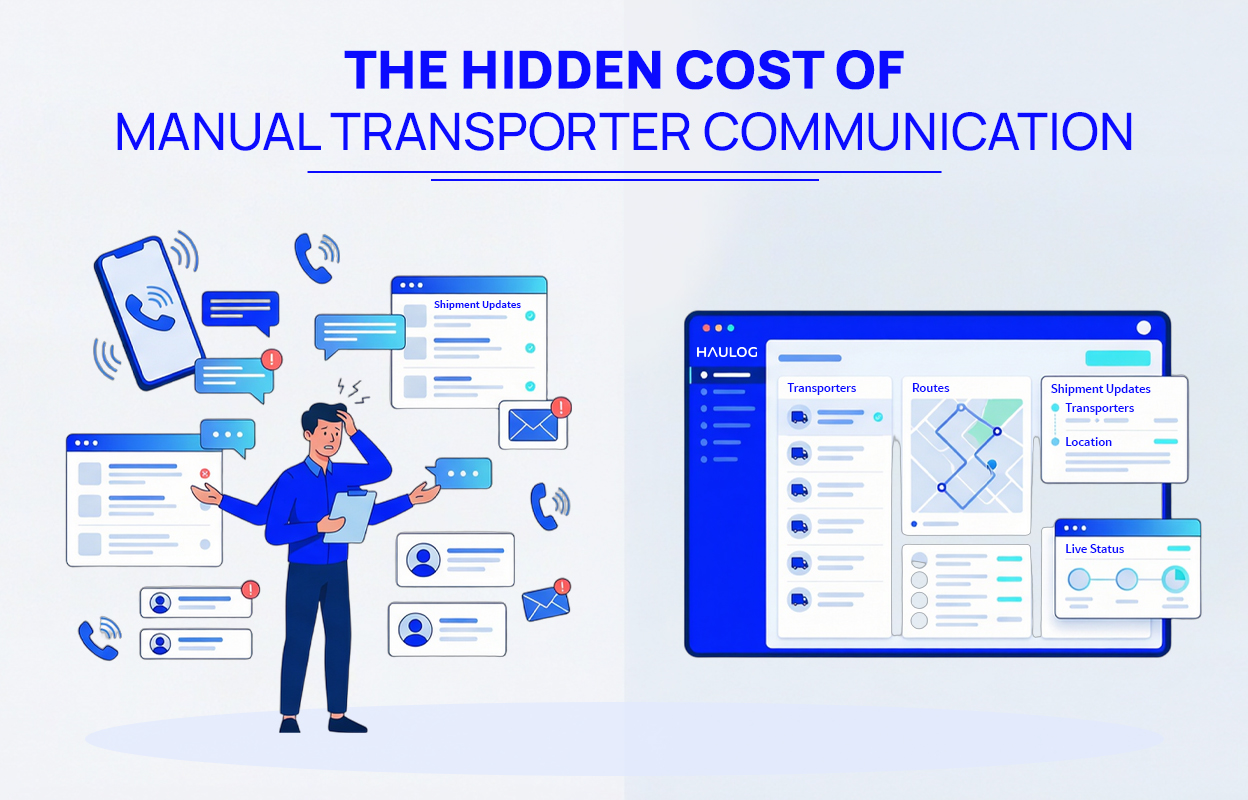
Most plants run on WhatsApp, calls, SMS and email all at the same time. The same information goes out across 3 to 4 channels and somehow still does not reach the right person reliably.
Calls happen just to confirm what was already sent on WhatsApp. Nobody knows which message is the final one. There is no trail and there is no single version of the truth that everyone is working from.
What one shipment actually costs in time
Most people have never counted it. A single shipment confirmation from indent to vehicle placement takes 4 to 6 touchpoints on average.
Scale that to a plant moving 20 to 30 trucks a day and you are looking at 80 to 150 manual interactions daily just to confirm what is moving. Just to confirm. Not to plan or improve anything.
When everything runs on one person’s memory
ETAs are gut feel. Proof of delivery is a WhatsApp photo that arrives two days late if it arrives at all. And if that one logistics executive takes a day off the whole operation quietly starts to fall apart.
That is not a people problem. That is what happens when a process lives in someone’s head instead of a system.
The incidents everyone knows about but nobody tracks
A transporter confirms a vehicle then shows up with a different one on dispatch day. Four to five hours lost at the gate. Two plants unknowingly book the same transporter and one gets no vehicle at all.
A rate agreed on WhatsApp gets invoiced differently and there is nothing solid to stand on. These are not rare situations. They happen regularly and the cost just gets quietly absorbed under detention charges and escalations.
Two to three hours a day just following up
Close to 30 to 40 percent of a logistics executive’s day goes into status checks, reminders and chasing confirmations that a system should be handling on its own. That is 2.5 to 3 hours every day not spent on planning or improvement. Just follow-up.
During month-end or peak season that number goes up and because none of it shows up in any report it rarely gets treated as the real problem it is.
Conclusion
Here is the honest truth. The people managing these operations are working harder than most people realise. The problem is not effort. The problem is that the entire coordination is running through personal WhatsApp threads, Excel files and phone calls with no accountability and no visibility built in.
When one person going on leave is enough to slow down an entire plant’s dispatch, that is a systems gap not a staffing one.Haulog is built specifically to fix this. Visit www.haulog.com to see how structured transporter communication actually works on the ground.
Get logistics & Transportation industry update and business insights
Suggested Products
-
Haulog - Shippers
-
Haulog - Carriers

Tags
Recent Posts
-
The Logistics Control Tower Playbook for Manufacturers
-
Dispatch Planning Maturity Model: From Chaos to Optimization

